
Jigsaw puzzles are a relaxing, screen-free hobby. They suit solo evenings and family tables alike. If you are new, a few techniques can make the first puzzle much more enjoyable. This guide covers choosing a puzzle, setting up a space, sorting, and finishing, plus storage tips.
Check age labels and supervise play around small parts, magnets, batteries, and chemistry kits.
Choose the right puzzle
Piece count matters. Younger children do well with large pieces and small counts, and adults often prefer 500 to 1,000 pieces. Look at the picture too. Images with clear sections and distinct colors are easier than large areas of sky or solid color. Check the age label if children will help.
Set up your space
- Use a flat surface you can leave in place, or a puzzle board or mat that can be moved.
- Provide good lighting.
- Keep the box lid nearby for reference.
- Keep pets and small children away, if possible.
- Use trays for sorting pieces.
Start with the border
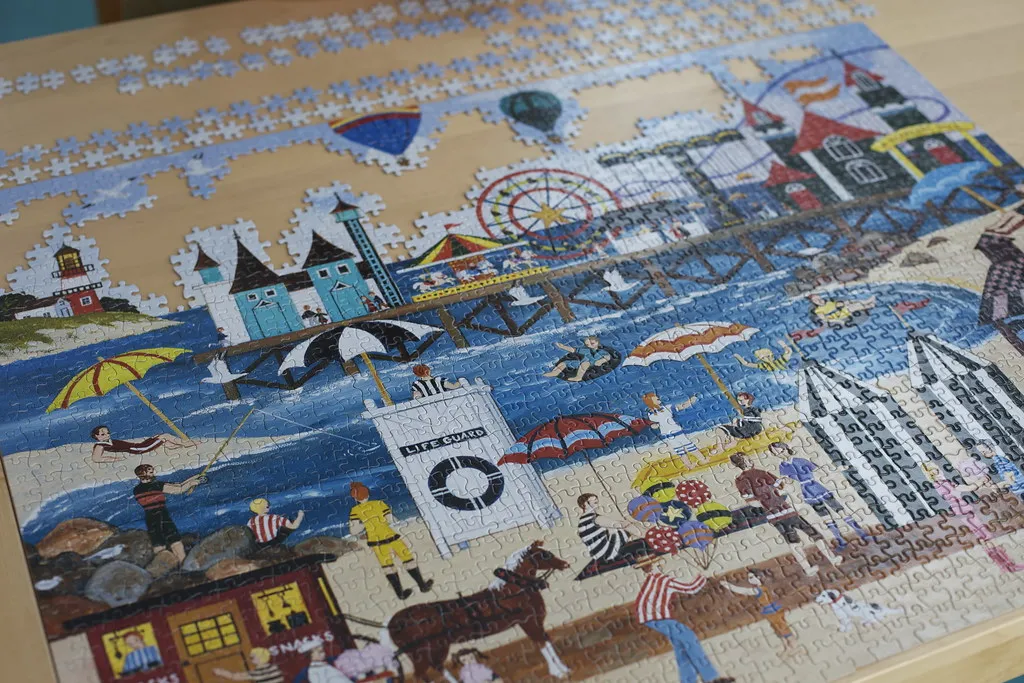
Find all the edge pieces, which have a flat side, and build the frame first. It gives you the size of the puzzle, and a boundary to work inside.
Sort the rest
Sort remaining pieces by color, pattern, or feature. Use trays or lids. Group pieces with similar features: sky, buildings, trees, text. Sort by shape if the picture is hard, such as pieces with one tab or two tabs.
Work in sections
Pick a distinct part of the image and assemble it separately. Then place it in the frame. Working in small chunks keeps you motivated.
Use the box picture
Look at the reference image to find where pieces belong. Some people also take a photo of the box on their phone to zoom in on details.
Try each piece
If a piece does not fit, rotate it. Look at the shape of the tabs and blanks. If you are stuck, take a break. Fresh eyes spot things quickly.
Do not force pieces
Pieces that fit properly slide in easily. Forcing them can damage the puzzle. If it does not fit, it probably belongs elsewhere.
Make it social
Puzzles are perfect for shared time. Work with a partner or children, and let each person take a section. See family game night for ideas.
Skills puzzles build
Jigsaw puzzles tend to build patience, visual perception, and persistence. They also provide a calm, low-pressure activity. See logic puzzles for kids.
Storing a work in progress
- Use a puzzle mat that rolls up.
- Slide the puzzle onto a board and store it flat.
- Keep it away from heat and moisture.
- Store loose pieces in zipper bags with labels.
Finishing and keeping
When you are done, you can take a photo, disassemble the puzzle, and store it in the box. Some people use puzzle glue and frame completed puzzles. Follow the glue instructions and use in a ventilated area.
Cleaning and care
Wipe the table before you start. Do not eat near the puzzle. Keep drinks away. Store puzzles in a cool, dry place.
Missing pieces
If a piece is missing, check the floor, under furniture, and in the box. Some makers help with replacements. Check the maker’s website.
Safety
Puzzle pieces can be choking hazards for young children. Keep them away from babies and toddlers. See toy safety: small parts, magnets, and batteries.
Frequently asked questions
How many pieces should a beginner try? Many beginners start with 300 to 500 pieces. Children may prefer 24 to 100 larger pieces. A puzzle that is a little too easy is better than one that causes frustration.
What if there are no edge pieces to start from? A few puzzle shapes have no straight edges. Start with a distinct part of the image, like text or a bright color, and build outward.
Can I leave a puzzle out for days? Yes, if you have a space. A mat or a board lets you move it without breaking it apart.
The takeaway
Start with the edges, sort by color or pattern, work in sections, and enjoy the process. Our researched top-10 list lists puzzles and games with links to official pages.